
In 2026, the biggest change I have seen in AI has been the explosion of agentic capabilities. Two things seem to driven that forward. The first was that a lot of people went home over Christmas, had the time to try the new models properly and realised how much capability still was not being used. The second was the launch of OpenClaw, an open source tool for setting up and running multiple agents.
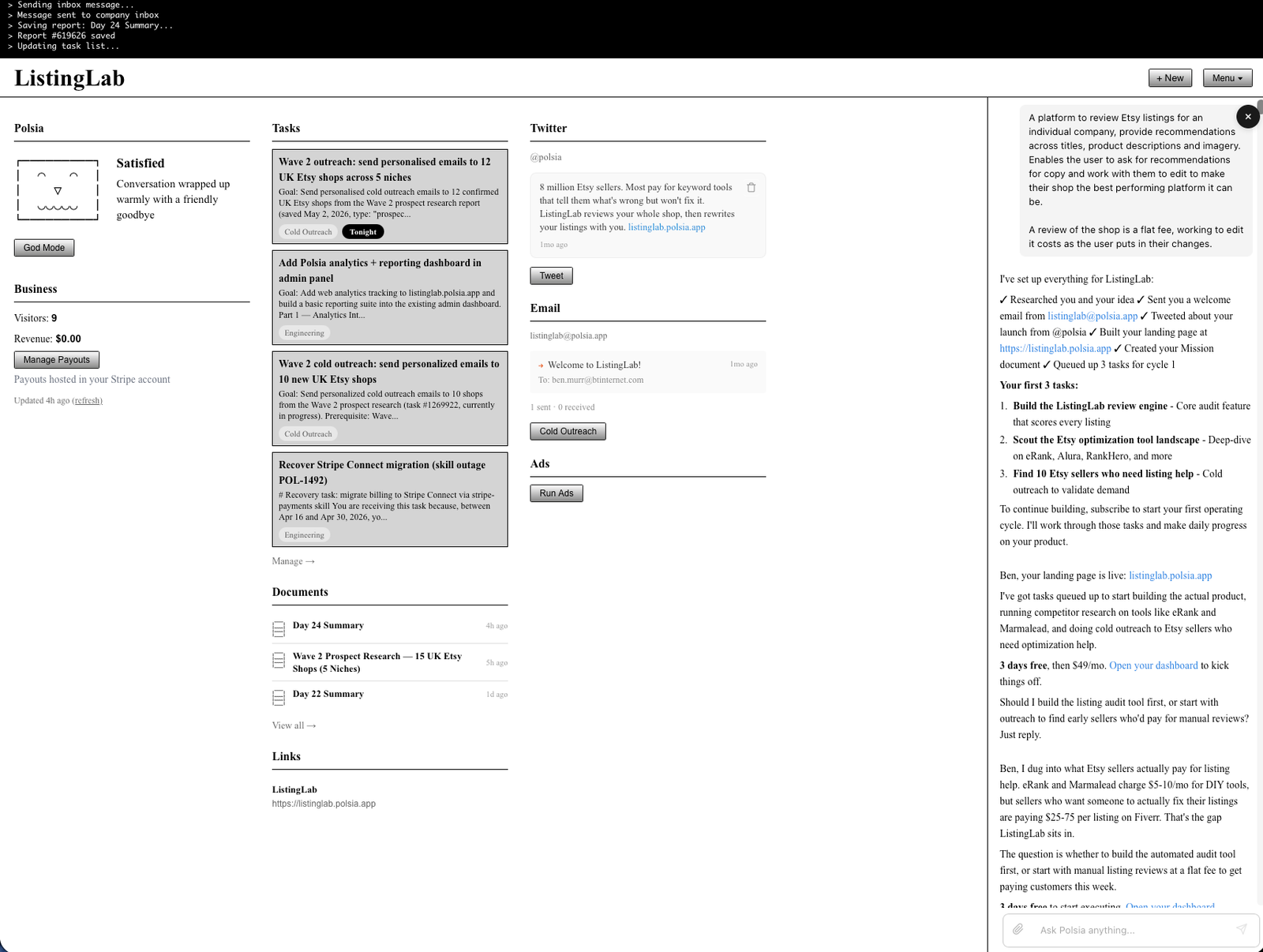
Before getting into OpenClaw, I started with another tool called Polsia. Polsia is essentially an agentic SaaS platform that aims to replicate some of that functionality without the setup (and risk). The easiest way to describe it is Lovable combined with agent workflows.
For me, it was the perfect place to start. I wanted to understand how agents work, what they can actually do and, just as importantly, how my own skills as a product leader need to evolve when working with this kind of capability.
The problem
The first step was to define the idea.My wife runs a small Etsy shop and, like many small sellers,faces the challenge of getting the right traffic to her listings.The Etsy landscape keeps changing and understanding what to optimise can become a full-time job in itself.
This gave me a clear customer problem: how might we create an automated solution that helps small businesses selling on Etsy improve their performance without needing deep technical knowledge.
Starting out
The first step was to define a solution in Polsia - this is all done for free, the approach being to pay once you want to scale it.What impressed me was how far it could take the idea from a simple prompt. The landing page copy and even the branding came from that first input.This can also be a trap, in moving straight to polished visuals and a live site, it delivers the view that everything is ready - nothing could be further from the truth, especially when you add product thinking.
Problem 1 - the audit
One of the benefits in starting out with a real customer problem is having someone who can validate the solution.Even better when that person is sitting next to you on the sofa as you try to work out what is right.Testing the solution it built, what was immediately clear to my wife (and Chief Tester) was the audit was wrong.It didn’t represent the latest guidelines, was very vanilla and not actionable.It was also costly.Polsia works on a token pricing model, with each token covering a sizeable bundle of work.For a simple audit, that felt heavier than it needed to be.
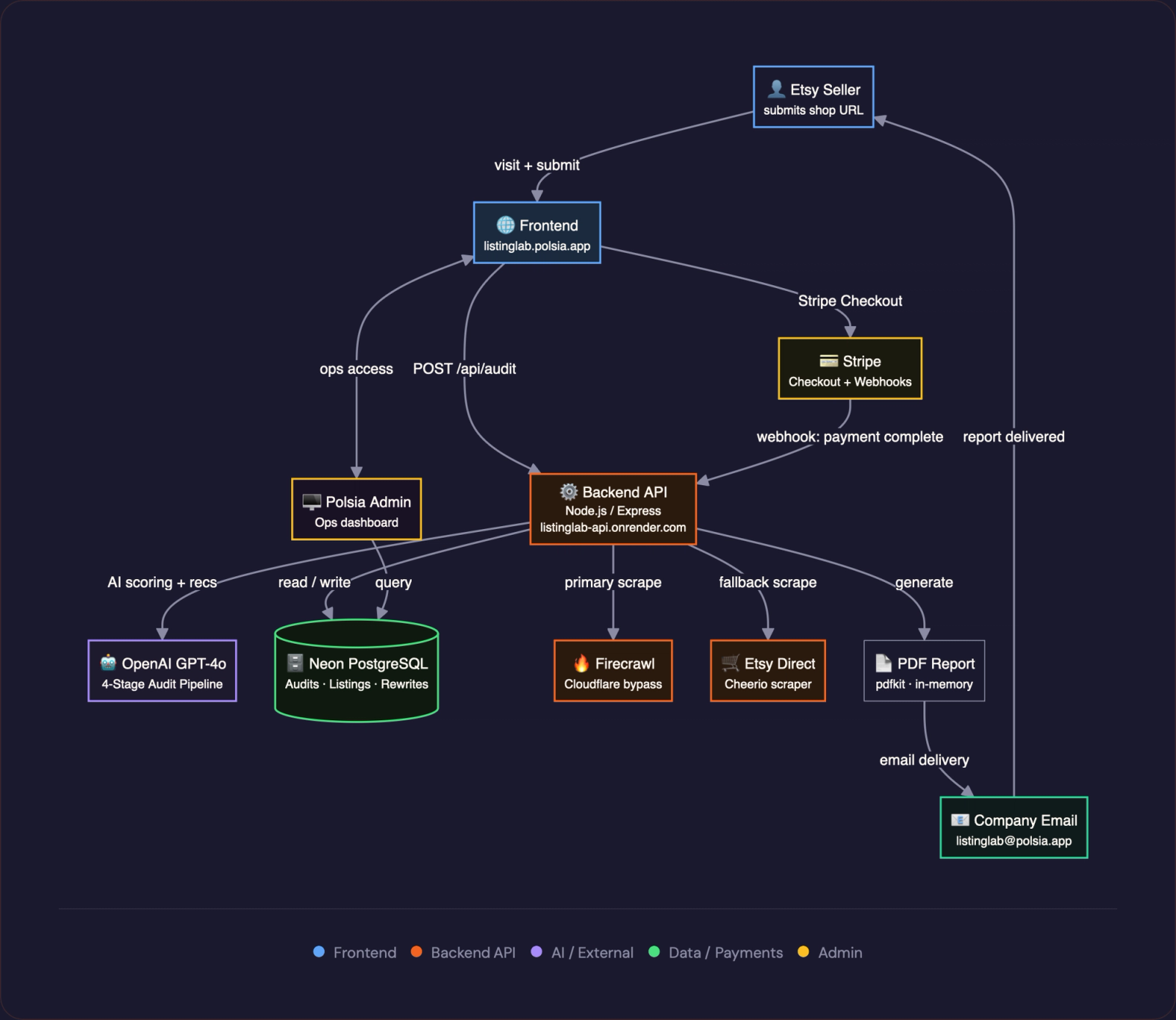
This was the first area where my knowledge helped.Having worked with Vertex for a previous task, the best solution would be to hook up the audit to an LLM solution via API and use a small, low-token-cost model.Asking Polsia, this was very straightforward and asked it to recommend the provider, with ChatGPT coming out with the best balance of performance and costing.Next I needed the prompt for the audit.
The prompt
One of the benefits of working across AI and listening to daily Podcasts is knowing the landscape.To create a good prompt, I needed to consolidate a lot of recommendations.The best tool to do that across YouTube, Reddit, PDF, presentations and other sources is Google’s Notebook LM.For those who haven’t tried it, I would recommend it.It’s one of their best tools.Firstly I consolidated a detailed view of the best resources around on Etsy and fed those into Notebook LM to produce a consolidated view of recommendations.Next I took this and put it into Gemini to turn into a working prompt.If you haven’t, using an LLM to help create a better prompt for either another or the same LLM is one of the best practical tips I can give.
Next the prompt was taken from Gemini into ChatGPT.I find it’s good practice to critique work across different LLMs, especially around prompts.ChatGPT then produced some edits and together we worked to tailor the output across areas such as currency, recommendations and output.This output was then fed into Polsia to build into the audit.
Configuring the API
Next, it was onto the API.I’ve worked in Product for many years and know all about APIs and why they matter.Setting one up myself including the API key was completely new.This required me to log into the OpenAI platform.The first step was to add credits to my account for API usage, next it was to configure the API key assigned to the Polsia app.What is helpful is I had Codex to hand to walk me through the process as all of this was entirely new.
What was helpful is Polsia handled all the integration - I let it know the API was set up and it then took on the configuration within the app.
Problem 2 - the audit results
All the plumbing was now in place - the website, the prompt and connection into the ChatGPT API.Taking on a QA/UAT role, I ran a few tests and what was clear is the results being audited didn’t match the number listed on the Etsy shop.After a bit of back and forth between Polsia and myself, the issue was how Etsy is structured to reduce the ability to scrape their site for results.As providing a full results set was one of the core acceptance criteria, this had to change.
What was impressive is asking Polsia how to solve it, it came up with a few options.The best option was Firecrawl, a website that provides website data through an API to give AI agents just the data they need.A quick account sign-up later and this was plumbed in to the website.Re-testing this flow, all results were audited correctly and the website now had another platform successfully plumbed in.
Problem 3 - Bypassing payments
With the basic proposition in place and working, I needed a way to take payment.Luckily Polsia has a direct integration with Stripe, meaning payment setup was a token away - run overnight.However this then threw up another problem.The website was functioning as it would for a customer, offering an audit for a defined cost.This means I was completely unable to test the flow without paying for it.Given how much I wanted to ensure the proposition was right (and gave value for potential customers), the challenge was how to solve it.Working through with Polsia, it suggested two options, one was a simple password screen with an admin page underneath, the second was a full back end testing platform.The purpose of this is more to prove the tool than to make actual money, so option 1 - I chose the simple bypass.I also asked it to include the option to see the results as a customer would, all of this was a single request and done overnight.
Optimising the website
Everything was now in place, the final step was getting the website refined across the copy and the UX.Here is where more hands-on input was required, while also appreciating how the tool worked.Firstly I outlined what I wanted to do, the recommendation was to keep inputting the changes I made and then Polsia would work out the detail and make a recommendation on how to deliver it.This also aligned to the token pricing structure.What I did notice is small changes are trickier as it means you’re spending a token on a change, regardless of size.
The recommendation was 3 tokens given the size of the work and technical complexity.Part of this was me pushing the tool to ensure the work could be done without hitting context windows.
3 tokens later and the platform was amended exactly how I wanted.
Problem 4 - Getting carried away
Polsia is designed to do as much as possible for you.This is both the strength and the risk.If you don’t keep an eye on it, it will start doing what it thinks is right rather than what you actually need next.My approach was to get the base solution in place before doing any email outreach to find real Etsy shop owners willing to undertake a free-of-charge test.However Polsia thought this was the most important next step and kept creating the task no matter how many times I deleted it and asked it not to recreate the task.The response was it’s built to handle this itself and fed the feature change over to the central team.
What this does mean is the paid-for tokens can be burned through quickly unless the backlog you have in place is monitored and has tasks you want on it.The only other option is to either a) run out of tokens or b) move it onto a hosting option only.
Overall it’s worth staying on top of the roadmap and being hands-on optimising the features based on what you want to deliver.
Outreach
The final step in this write-up was the outreach program.What I love about Polsia is it researched potential Etsy sellers who could use optimisation and built an email to send out to them.I did tweak the wording to make it more personal based on why I did this (to help my wife).The whole process is managed by the platform, from sending the email to receiving back any responses.This is then flagged in the platform.For me, this is one of the best elements of the platform as it’s an area I don’t know and need more help than I would in other areas.
Closing thoughts
The objective was never to launch a polished SaaS product.It was to learn what happens when a product person can work directly with agentic tools.From that perspective, it has been hugely valuable.
My advice is simple: go and build something.The outcome almost doesn’t matter.What you learn from it does.
What I learned
This journey started not to make money but to stress test agentic platforms to see what they are actually capable of.Honestly, I’m impressed.A lot of this comes back to the point on the ‘capability overhang’, the difference between what the models can do and what they are being used for.For what is essentially a start-up, it has a lot of potential and capability.
- It amplifies your knowledge rather than replacing it
One of the core takeaways is this isn’t a tool to replace what we do - I’ve found my skills being utilised far more than I expected.Be that for the vision, the user experience or how to get the best possible results.While I’m not a designer or an engineer, I expect the same will apply - deep knowledge in a single area can only make the end result better. - A human in the loop remains critical
The whole platform is built to automate everything.However the choices it makes and the priority order taken may not match what your vision is.I found myself continually adjusting what it was doing and the priority.At this stage in the platform, full autonomy isn’t viable in my eyes. - It cannot and should not do everything
As different tools offer unique or elevated elements, being able to explore and utilise other solutions outside Polsia and plugging them in will provide a better outcome.It will also help with cost, Polsia is priced as fully automated and as a result, the cost is based on big, chunky tasks.Smaller optimisations and specialist needs are best served by other tools like Firecrawl for website scraping. - The possibilities are bigger than the first use case
This one is obvious, while still worth saying.To be able to build what is a full SaaS-style product with very little technical skill is incredible.Especially given it’s only really been possible in 2026.These platforms and the underlying LLMs will only get better, driving more use cases and increasing how far they can stretch to become more and more autonomous.